The robot works. The demo is flawless. The deck is sharp. And then, somewhere between that moment and a running production line, everything unravels. This is not an isolated story but the defining pattern of industrial robotics in 2026. At the Boston Robotics Summit, I said it plainly: most first deployments fail, not because the technology is weak, but because the path from a capable AI to a robot that actually ships and scales inside a real industrial environment is far harder than the market wants to admit.
Industry is not the easy market: it’s the hardest one.
Robotics teams are right to target industrial applications, repetitive tasks, labor pressure, genuine appetite for automation, but treating industry as the obvious home for robotics obscures what deploying there actually requires. Industry runs on uptime, meaning the continuous, uninterrupted operation of its production systems, and when a robot at a bottleneck position goes down, the cost is not a support ticket; it can reach $11.9 million per day.
Industrial buyers don’t purchase potential; they purchase proven reliability, backed by certifications including ISO 15066 for human-robot collaboration safety, ISO 45001 for occupational health, and Electromagnetic Compatibility (EMC) certification, which ensures the robot doesn’t electrically interfere with surrounding systems. Miss a single EMC test late in development and you are not patching a bug: you are rebuilding the electronics from scratch, with up to six months lost and $5 million burned. Most teams discover this cost too late, which is precisely why they end up paying it.
The real problem: AI maturity and hardware maturity run on different clocks
The most underestimated challenge in robotics today is the desynchronization between two dimensions of readiness: the Technology Readiness Level (TRL), which measures how validated and mature the AI system is, and the Manufacturing Readiness Level (MRL), which measures how ready the hardware is to be produced reliably at scale.
A team can be at TRL 7, with their prototype validated in a real operational environment, while sitting at MRL 4, where manufacturing has only been demonstrated under lab conditions. The AI works, but the hardware cannot yet be produced consistently, so the product exists in demos rather than factories.
The inverse fails just as completely: a perfectly engineered platform running an unvalidated AI stack is, in practice, a very expensive chassis. TRL and MRL must advance in parallel, or neither will reach 9, the threshold for full production readiness, and this desynchronization is the mechanism behind most robotics’ stalls between prototype and production.
Hardware doesn’t iterate like software: ignoring that is expensive.
AI improves continuously as models ingest more data, and deploying an update is a software operation that takes hours.
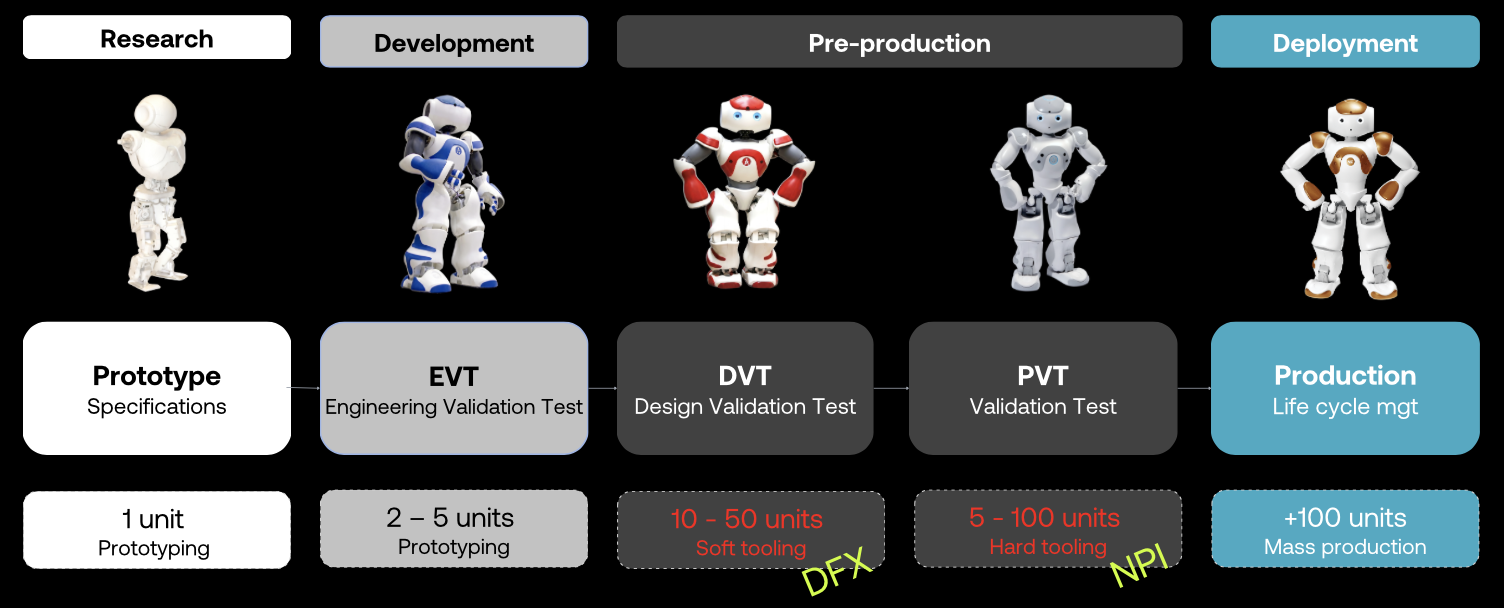
Hardware follows the opposite logic, moving through a fixed sequential path: Prototype → Engineering Validation Test (EVT) → Design Validation Test (DVT) → Production Validation Test (PVT) → mass production. Every design change at DVT simultaneously resets tooling commitments, supply chain timelines, and compliance testing.
This tension between the iterative nature of AI and the sequential discipline of hardware cannot be resolved retrospectively; it requires a synchronized development architecture from the very first prototype, which is why decisions made in the earliest weeks of a program carry consequences that compound all the way to mass production.
Design for Excellence is not a phase: it’s a foundation.
The discipline that bridges this gap is Design for Excellence (DfX), a set of engineering principles covering manufacturing, cost, certification, reliability, and AI integration, embedded from prototype stage rather than added at the pre-production gate when it is already too late. Three principles prove most decisive.
Design for Certification means building regulatory compliance into the architecture before a single Printed Circuit Board (PCB), the electronic core of the device, is finalized. Retrofitting EMC compliance (Electromagnetic Compatibility) into a mature hardware design is a known, avoidable, and costly catastrophe.
Design for Cost means targeting the volume price from day one, not the sample price. The deployable industrial robotics market lives under $100,000 per unit, and the Bill of Materials (BOM), the complete list of every component and its production cost, is where commercial viability is actually decided, not in the pitch deck. Your prototype is a promise; your BOM is the truth.
Design for AI means accepting that every model architecture decision has a direct hardware consequence. A system requiring a data center-grade GPU (Graphics Processing Unit), the chip that handles heavy computation, cannot simply be ported to a 10-watt embedded platform, which means decisions around processing power, response speed, and offline operation must be made early, not treated as deployment afterthoughts.
NPI is a debugging phase, treating it as production kills ramp-ups.
New Product Introduction (NPI), the bridge between a validated design and the first true production runs, exists to surface every assumption that didn’t survive contact with the factory floor. Teams that mistake it for a production phase consistently face quality variance, assembly failures, supply chain gaps, and re-engineering cycles that burn launch budgets and slip timelines by quarters. The teams that ramp successfully know NPI is structured debugging, and staff and budget it accordingly.
What this means in practice
The industrial robotics opportunity is real, and the technology has never been more capable, but capability without industrialization discipline is a demo, not a product. The teams that consistently ship architect for scale from prototype one, synchronize AI and hardware maturity, and design for the price the market actually pays. At Kickmaker, engineering innovators’ ambitions into products that survive the real world, at the right volumes and costs, is what we excel at.